
See exactly where your purchasing loses money.
Suppliers invoice too early. Departments buy around procurement. Requisitions sit untouched. mpmX analyzes your transaction data in real time, catches early invoicing, maverick buying, and late purchase orders, blocks payments on mismatches, and alerts the right buyer within seconds.
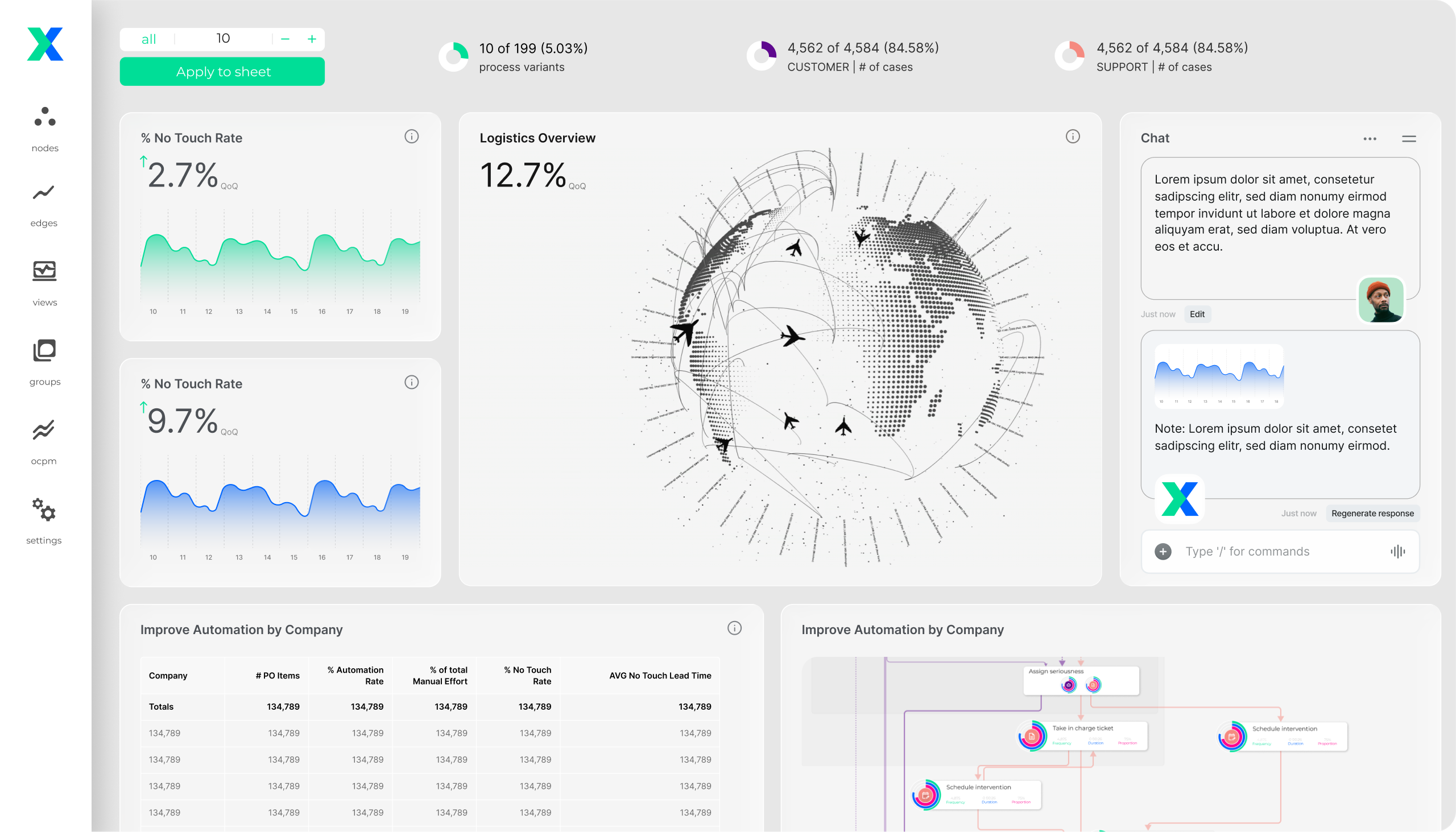



What process intelligence actually does for procurement.
No projections. No estimates. Numbers from live customer projects.
$3.2M
An automotive supplier with 5,000 employees automatically blocks invoices that arrive before the goods do. The result: days payable outstanding goes up, and the cash stays in the business longer.
$2.1M
A machinery manufacturer with 29,000 employees now catches rogue purchasing in real time, the moment a business unit buys outside of procurement. That visibility alone saves millions and puts someone finally in control of actual spend.
7%
By automatically identifying master data inconsistencies, purchase orders go out faster. Fewer back-and-forths, fewer delays, better on-time delivery.



Four Use Cases. Measurable results.
mpmX tackles the most common and costly weak spots in the procurement process with ready-to-deploy business apps that go live in days, not months.
Suppliers invoice before the goods show up. Your DPO pays for it.
When a supplier sends an invoice before the goods are received, the payment clock starts right away. The money goes out earlier than agreed. Days payable outstanding drops. And your team usually only notices at month-end close.
mpmX automatically compares the invoice date against the goods receipt date. If the invoice comes in too early, the payment gets blocked and your team gets an alert. Suppliers with suspicious patterns are flagged for targeted audits. Buyers can see at a glance which supplier invoices early and how often, how much working capital it ties up, and where a conversation with the supplier would have the biggest impact.
- More free cash flow, because the money stays in the business longer.
- Targeted supplier audits instead of blanket checks.
- A dependable DPO that no longer hinges on how a handful of suppliers behave.
€3.2M in DPO improvement per year
Automotive supplier with 5,000 employees
Background: 72,530 affected PO line items, total volume roughly €370M.
When departments buy without procurement, money leaks out. Usually unnoticed.
A colleague needs software fast. They order it straight from the vendor without looping in procurement. No framework agreement, no discount, no paper trail. Multiply that across departments and countries and it becomes a structural problem in your cost base.
mpmX automatically detects when goods or services are bought without a valid ordering process: orders with no PO reference, free-text requisitions, direct supplier invoices with no purchasing approval. Your procurement team gets instant alerts and can step in. The dashboard shows which departments are driving how much maverick spend and which suppliers are involved.
- Less uncontrolled spend and better use of the framework agreements you already have.
- Compliance you can prove to auditors and internal controls.
- A clear view of where process training or system changes would actually help.
€2.1M per year
Machinery manufacturer with 29,000 employees
The invoice is here. The purchase order isn't. That's a problem.
Departments order goods from a supplier without involving procurement. The delivery arrives, the invoice arrives, but the purchase order is missing. Finance has to chase it down after the fact. That costs time, creates rework, and lets every supplier operate outside normal process controls.
mpmX automatically detects when an invoice shows up in the system before its matching purchase order. Those cases are flagged immediately and the responsible teams are notified. A reactive process becomes a proactive one: procurement sees the problem before the payment is due.
- Less manual rework in finance and procurement.
- More control over supplier relationships that run outside defined channels.
- A real-time view of where the process is being bypassed systematically.
€2.1M per year (combined with maverick buying)
Machinery manufacturer with 29,000 employees
When a purchase requisition never turns into an order, you end up short on stock.
A purchase requisition gets created and lands in a queue. Nobody escalates it. The order goes out late. Worst case, production runs short on material or a service provider can't start on time. Controlling only sees it after the fact.
mpmX tracks every single step from purchase requisition to released purchase order. Delays become visible immediately. Your team gets alerts before a bottleneck forms. The dashboard shows where requisitions are piling up, which categories or buyers are affected, and how cycle times compare against your benchmark.
- Shorter cycle times mean fewer stockouts and fewer production delays.
- Procurement leads can finally see where the process consistently gets stuck.
- Escalations happen automatically, not because someone went looking.
€169,000 per year
Advertising services provider with 16,000 employees

Real results from those who took the leap





Common Questions About Process Mining in Procurement
Common questions about process mining in procurement

Process mining analyzes how every single transaction actually runs, not just aggregated metrics. A traditional BI tool tells you at month-end that DPO went down. Process mining tells you which 72,530 PO line items had an invoice raised before goods receipt, which supplier keeps repeating that pattern, and what it means in euros. And it acts on it directly: payment blocks, alerts, automated compliance workflows. That's no longer reporting. It's active process management.
Maverick buying is any purchase that happens around procurement: a department orders straight from the supplier, no PO, no framework agreement, often without procurement even knowing. The problem usually isn't bad intent, it's convenience and a lack of visibility. Because no traditional system pulls these cases together systematically, the real scale stays invisible at most companies. mpmX makes it visible: which department, which supplier, how much, in real time.
Because the problem starts in the purchasing process: the supplier sends the invoice before the goods arrive. From that moment, the payment clock is running. AP pays too early because the invoice looks correct in the system. Procurement is the only function that can spot this pattern across all suppliers and fix it for good through audits or process changes. AP can block individual cases. mpmX gives procurement the full picture across every supplier.
It doesn't, in the traditional sense: mpmX comes to your data, not the other way around. The platform integrates natively with your existing infrastructure, whether that's Snowflake, Databricks, or Qlik. Plenty of pre-built connectors link SAP, Oracle, SAP Ariba, Coupa, and other procurement source systems. That means most of the ETL work is already configured instead of being built from scratch for every project. If you don't have a central data platform yet, you can run mpmX as a standalone solution, in the cloud or on premises.
mpmX is built for fast time-to-value. Pre-built templates for purchasing, like purchase-to-pay, mean no process has to be built from scratch. Templates like Early Invoicing or the Late PO Monitor are often up and running in a matter of days. It moves that fast because mpmX integrates natively with your existing infrastructure, which takes the heavy data prep out of the picture.
Start today with mpmX or talk to an expert
Real businesses solving real problems. Watch how mpmX uncovers hidden inefficiencies and turns complex data into actionable intelligence.







Procurement Process Mining Insights
Lorem ipsum dolor sit amet, consectetur adipiscing elit. Suspendisse varius enim in eros elementum tristique. Duis cursus, mi quis viverra ornare, eros dolor interdum nulla, ut commodo diam libero vitae erat. Suspendisse varius enim in eros elementum tristique. Duis cursus, mi quis viverra ornare, eros dolor interdum nulla.

Accounts Payable – A case for Process Mining

BPM and Process Mining as team players

Difference between OCPM and Process Mining
Process Mining that fits your organization
Discover even more resources
