

Improving returns processes with Process Mining



.webp)



They have been a hotly discussed topic in eCommerce for years. It's the big trading platforms like Zalando and Amazon that tend to make the headlines, but every online store – from start-ups to concerns – has to deal with them: Returns. The return process is a critical process in eCommerce in many ways. From the costs incurred to the issue of legal security to customer satisfaction and customer lifetime value, the returns process plays a decisive role in the success or failure of an online store.
We take a closer look at the return process and present a technology that reveals stumbling blocks, cost traps, optimization and automation potential at the touch of a button: Process Mining.
The biggest cost drivers in the returns business
Returns management consists of many sub-processes and to-do's. The following graphic gives you an overview of the biggest cost drivers in the returns business (2019).
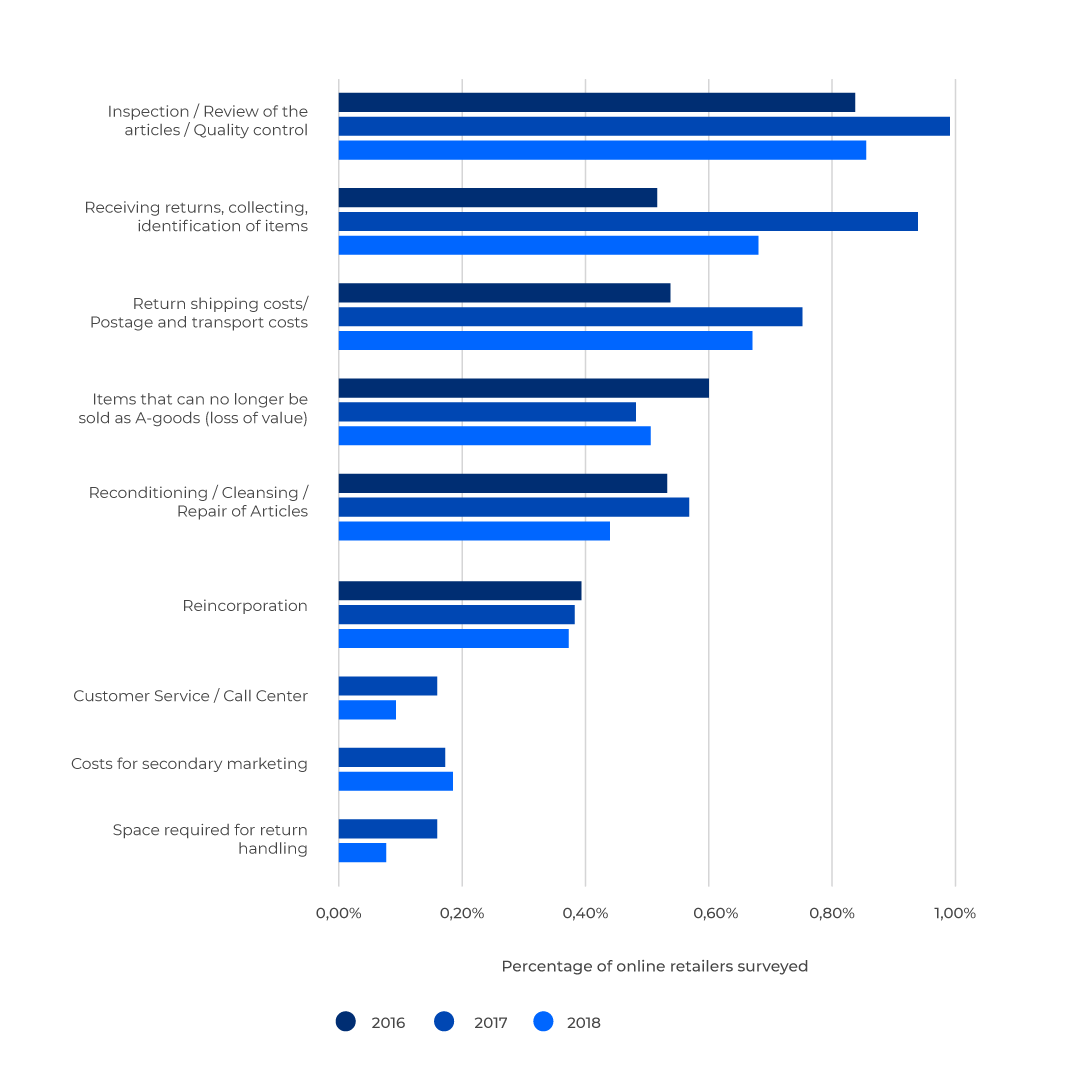
In addition to the pure costs of return shipping, costs are created in particular in internal processes, or from the time and resources that these entail – and these are difficult or impossible to capture with standard evaluations. The use of incorrect return rates and incomplete data from ERP (e.g. SAP), CRM and / or merchandise management for forecasts and personnel planning also cause problems.
Getting to the bottom of inefficient processes and costly stumbling blocks is almost impossible without the necessary end-to-end transparency, i.e. an objective and holistic view of all processes that take place every day in returns processing. And this is where Process Mining comes into play.
PROCESS MINING
[ˈprəʊ.ses ˈmaɪ.nɪŋ], the; (Business Process Discovery)
Automated business process analysis – with all relevant key figures - based on digital traces in IT systems. Implicit and otherwise hidden process knowledge contained in data is visualized and thus becomes tangible and transportable.
The "process X-ray machine" Process Mining
Process Mining is a process analysis technology that enables digital data traces from different systems to be combined, interpreted and automatically visualized – in the form of an interactive process flow, which is equipped with important key indicators.
What can Process Mining do to optimize eCommerce processes?
- Measuring and visualizing KPIs (Key Performance Indicators) and PPIs (Process Performance Indicators)
- Analyze performance and compliance of the as-is processes
- Analyze process variants, uncover bottlenecks and compare processes
- Automatically uncover causes of bottlenecks and cost traps
- Combining data and user behavior from different systems, e.g. store system, ERP, merchandise management, CRM ...
- Discover automation potential
What goals are achieved by using process mining in returns management?
- More efficient processes
- Higher degree of automatization
- Resource and cost savings
- Increased customer satisfaction and customer lifetime value
This article could easily go on for several more lines in order to comprehensively illuminate the topic of Process Mining in eCommerce with a focus on the return process – but sometimes a real use case helps more than the bare theory. And Nelly.com proves that the use of process mining in eCommerce is not just hot air, but helps to achieve real competitive advantages.

More Articles
Dive in and discover a world where every process tells a story. Turn data into your advantage – unleash its potential with Process Mining andtransform your processes into success stories.

Toolbox automation: 4 basic tools you need to automate business processes


The hype surrounding Digital Twins – What’s behind it?

The Bank’s Digital Twin: Process Intelligence as the Engine for Customer Experience & Compliance
Process Mining that fits your organization

